Thursday, 20 June 2013

Mohammed Assaf: The Legend

Mohammed Assaf: The Legend


On June 22 in Beirut, 23-year-old Mohammed Assaf became the first
Palestinian to win the Arab Idol contest, earning more than 67 million
votes—the highest tally in the history of the competition.

After the announcement, Palestinians took to the streets of  Khan
Younis refugee camp, where Assaf lives, as well as in Gaza City,
Bethlehem, Nazareth, Jerusalem, Lebanon, Jordan, and elsewhere within
the Palestinian diaspora to celebrate his victory. Fireworks erupted,
tears of happiness rolled down the faces of his fans, and chants were
sung by dancing, joyful crowds. Meanwhile, Gaza’s Ministry of Culture
welcomed Assaf with an official reception upon his arrival to the
Rafah crossing separating Gaza from Egypt.

Nationalistic poems, patriotic hymns, and love songs have always been
an integral part of Palestinian culture, literature, and folklore.
They reflect our lives, shared history and culture, and most
importantly, our spirit and determination to live on despite
oppression, occupation, and state-sponsored violence.

That, perhaps, is why Moshe Dayan, Israel’s former defense minster,
famously remarked that just one of late Palestinian poet Fadwa Tuqan's
poems was "the equal of 20 [Palestinian] commandos."

Born in Libya and raised in Khan Younis refugee camp, a place that his
parents made home, Assaf made a point of singing traditional
Palestinian folk songs during his Arab Idol bid, thus endearing him to
Arab audiences from the Mediterranean to the Gulf. That he did so was
an act of affirmation: After all, his own grandparents were expelled
from the Palestinian village of Beit Daras, which was destroyed and
depopulated by Israel in 1948.

In other words, Mohammed, who has never been to his grandparents’
village, sang for a collective Palestinian patrimony, one that lives
on three generations after our people’s Nakba, or catastrophe. For
millions of Arabs still scarred by the ethnic cleansing of Palestine,
in which three-quarters of its indigenous population either fled
Israel’s creation or was expelled by its merciless militias, Mohammed
is truly an Arab idol.

How he got there illustrates even more profoundly why he deserves the
title. After struggling to enter Egypt from Gaza, Mohammed was late to
the Arab Idol auditions in Cairo. There, it was his mother who
encouraged him not to give up, a boost that helped Mohammed literally
scale the walls of the audition grounds, only to find out that there
were no spots left at the tryouts. Sitting among the other
contestants, holding back tears, he began to sing. The warmth and the
purity of his voice convinced another contestant, also from Gaza, to
give Mohammed his ticket.

The rest, as they say, is history. But Mohammed’s history is
inextricably bound with his people’s. Perhaps the surest proof of that
is that this budding superstar must have Israel’s permission to
perform in the Palestinian West Bank. Going there, though, is a
revolutionary act and one Mohammed is determined to see through. As he
told an Al Jazeera interviewer after his win:

“The revolution is not just the one carrying a rifle. The revolution
is the paintbrush of an artist, the scalpel of a surgeon, the ax of a
farmer. This is something I consider to be logical. Everyone struggles
for their cause in the way they see fit. Today I represent Palestine
and today I'm fighting for a cause also through the art I am
performing and the message that I am sending out.”

Indeed, with such courage and poise, this young man has given a
much-needed lesson to Palestine’s political representatives, who could
only hope to earn a fraction of the votes Mohammed garnered—for his
voice and its authenticity—on that beautiful night in Beirut.


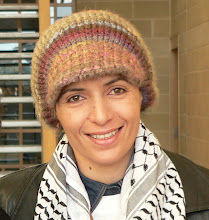
Ghada Ageel is a visiting professor at the university of Alberta/ Canada, an activist and a member of faculty for Palestine Alberta. Originally form Beit Daras village, Ghada is a third generation of Palestinian refugees and was born and raised in Khan Younis refugee camp


Thursday, 2 June 2011

Israel’s attack on the Gaza Freedom Flotilla: Looking back a year later


Israel’s attack on the Gaza Freedom Flotilla: Looking back a year later


Submitted by Ali Abunimah on Tue, 05/31/2011 - 08:00


A still from Iara Lee’s footage shows an Israeli Blackhawk helicopter as it drops troops onto the deck of the Mavi Marmara in the early morning of 31 May 2010.

In the early morning hours of 31 May 2010, Israeli forces carried out a violent, unprovoked assault on the Gaza Freedom Flotilla as it sailed in international waters in the eastern Mediterranean.

Israeli commandos in speed boats and helicopters commandeered the six ships killing nine people and injuring dozens more aboard the largest vessel, the Mavi Marmara.

The first alarming reports of the bloody Israeli attack on the Mavi Marmara came via Turkish television and I was able to relay reports and screenshots via Twitter and on my Posterous blog.

Amid intense Israeli efforts to jam communications, any picture, such as this one showing a person with blood on their life vest, gave vital clues to the seriousness and violence of the Israeli assault.

Countering Israel’s propaganda

Israel not only attacked the ships but commandeered them with all their passengers and crew to the port of Ashdod, where they were held incommunicado for many days. All video and photographic footage was confiscated, and media were not allowed to speak to the hundreds of kidnapped passengers. Israel has still not returned the footage and other evidence it stole.

In the first hours and days, Israel’s propaganda – or hasbara – machine went into full swing, publishing false and distorted reports and images – such as the infamous ‘man with a dagger’ photo, and heavily edited and misleading video.

Independent reporting, using information from sources ignored by mainstream media, was key to countering Israel’s propaganda.

Lubna Masarwa, one of the first Mavi Marmara passengers to be released from Israeli custody provided a harrowing eyewitness account, published by The Electronic Intifada on 8 June.

And despite Israeli censorship, independent filmmaker Iara Lee who was aboard the Mavi Marmara managed to smuggle an hour of footage off the ship and past her Israeli kidnappers.

Analysis of this footage has provided vital corroboration of what happened during the Israeli assault, including: the use of European and American weapons and indiscriminate live fire by the Israeli attackers. Iara Lee’s footage also provided a poignant glimpse of the last moments of Turkish journalist Cevdet Kılıçlar, one of the nine people killed.

The flotilla was attacked even as it tried to flee

The Electronic Intifada was able to plot the known positions of the Mavi Marmara on a map and by comparing with other evidence demonstrate that the flotilla was not only in international waters, but heading away from the Israeli coast when it was attacked.

Coverage highlights

Here is a selection of some of the reporting on my Posterous blog, and other coverage, in the days and weeks after the attack:
1 June 2010 Video: Adam Shapiro, Amira Hass, Ali Abunimah, Richard Falk on Democracy Now.3 June 2010 “The day the world became Gaza” - op-ed on Aljazeera.net3 June 2010 Did Israel try to assassinate Sheikh Raed Salah on Mavi Marmara but kill a Turkish engineer instead?4 June 2010 Proof emerges IDF audio of radio communication with Mavi Marmara is fabricated6 June 2010 Israel hasbara fails again: Photos show Mavi Marmara passengers protecting, aiding Israeli soldiersHasbara comedy video further exposes IDF “knife-attacker” photo fraud7 June 2011 Did Israel press on with bloody attack on Mavi Marmara even as ship fled at full-speed?8 June 2011: “The crimes I saw on the Mavi Marmara,” Lubna Masarwa13 June 2010 Video reveals European, American weapons used in Israeli attack on Gaza FlotillaFootage proves indiscriminate Israeli live fire at Mavi Marmara passengers in Gaza Flotilla14 June 2010 The last moments of Cevdet Kılıçlar, a working journalist murdered on the Mavi Marmara15 June 2010 “Independent journalists dismantling Israel’s hold on media narrative,” Abraham Greenhouse and Nora Barrows-Friedman.
Israel’s propaganda and the efforts to counter it were immortalized in Minor Demographic Threat’s brilliant Internet Killed Israeli PR, a parody of the 1979 hit Video Killed the Radio Star by The Buggles.

Finally, as a new flotilla prepares to head to Gaza this summer, Israel’s propaganda campaign against it is already in full swing.

Should the 1967 borders guide Israeli-Palestinian peace plan?


Should the 1967 borders guide Israeli-Palestinian peace plan?

Yes. But the details matter: no conditions, no 'swaps,' no settlements.


May 31, 2011

By Mustafa Barghouthi

President Barack Obama was right to call for a Palestinian state on the 1967 borders. But he should have stopped there. Instead, he added a damaging proviso about "mutually agreed swaps" of land.

Conditions and stipulations trouble Palestinians greatly. Israel used the Oslo Accords not to finalize a peace deal with the Palestinians but to expand settlements in East Jerusalem and the West Bank -- talking peace while seizing our land. Prime Minister Ariel Sharon was notorious for accepting what American Presidents asked of him. Yet in the next breath he would note his caveats.

Prime Minister Netanyahu imitated Sharon's approach two years ago -- and again last Tuesday in the U.S. Congress -- while reluctantly voicing support for a two-state solution. He said yes to a Palestinian state while simultaneously stripping it of meaningful sovereignty. Israel would maintain major settlement blocs, retain East Jerusalem and a military presence in the Jordan Valley, refuse the return of any Palestinian refugees to stolen homes and land, and ensure that a Palestinian "state" is a nonentity without real sovereignty.

Obama's political opponents and even some of his ostensible allies heavily criticized him by suggesting he was calling for the 1967 borders. In fact, he was merely restating long-standing U.S. policy that an agreement should be based on the 1967 borders, with land "swaps" (itself a euphemism for forcing a bad deal on Palestinian negotiators). Unfortunately he retreated even from this within a few days because of criticism from Israel and its defenders. In his address to AIPAC he went back to President Bush's position that borders will have to take into consideration new realities on the ground, which means acceptance of illegal Israeli settlement expansion.

Our best West Bank land and aquifers would go to Israeli settlements in exchange for sub-standard land elsewhere. Already, Israel uses 80 percent of West Bank water resources and on a per capita basis Israeli settlers use approximately 48 times more water than Palestinians. The current unjust water distribution is likely to be made permanent if Israel keeps settlements, all of which are illegal under international law.

Israel's retention of settlement blocs and a military presence in the Jordan Valley will make our state noncontiguous and nonviable. Our state would be little more than disconnected Bantustans. When the white South African government tried to foist such a plan on the world it was seen as repugnant. Palestinians are surely the holders of the same rights as black South Africans and can no more be expected to accept apartheid conditions than South Africans who rejected inferior rights.

Human Rights Watch recently lent credence to our apartheid concerns with a report detailing Israel's "two-tier" legal system in the occupied West Bank. Such discrimination in favor of settlers and against Palestinians ought to be regarded as reprehensible just as it eventually was viewed in the Jim Crow South. Tragically, it is visible every day in the West Bank.

Israeli threats to annex -- by dint of brute force -- West Bank land as a response to our nonviolent legal efforts this September at the United Nations are troubling. This would, however, highlight the apartheid nature of their policies as our "bantustanized" existence would become more visible. Denied statehood, our cause will eventually be transformed from pursuit of two states to a struggle within one state for one person, one vote.

It would be far wiser for Israel to recognize our state on the 1967 borders -- and the rights provided us under international law -- come September.

Mustafa Barghouthi, a doctor and a member of the Palestinian parliament, was a candidate for president in 2005. He is secretary-general of the Palestinian National Initiative, a political party.

The two speeches of Barack Obama

The two speeches of Barack Obama


By Josh Ruebner - 05/20/11 11

During his speech today at the State Department, President Obama rightfully noted the “hypocrisy of the Iranian regime, which says it stands for the rights of protesters abroad, yet suppresses its people at home.”

But President Obama’s bifurcated speech—the greater part of which centered on the human rights of people throughout the Middle East and North Africa, the lesser part of which re-trod perfunctorily on the Israeli-Palestinian “peace process” — points to an additional double standard that the United States must overcome if it is to have a coherent response to the Arab Spring.


The United States cannot continue to decry violent repression by governments against individuals acting to assert their fundamental human rights while continuing to provide Israel with the means—both weapons and diplomatic support — to continue its human rights abuses of Palestinians without mocking the values it claims to support universally.
President Obama asserted that “we will stand against attempts to single it [Israel] out for criticism in international forums.” Yet, by erasing Palestinians from the Arab Spring and trying to shoehorn Palestinian rights into a moribund and morally bankrupt “peace process” that, under the monopoly of U.S. brokerage, perpetually sublimates Palestinian desires for freedom, justice, and equality to Israel’s “security interests,” it is the President who singles out Israel for special treatment.

By placing Israel’s policies toward Palestinians, and Palestinian efforts to undo those discriminatory policies through nonviolent struggle, outside the context of the changes buffeting repressive regimes throughout the region, President Obama signals that Israel need not abide by the standards to which the United States holds regimes like Libya and Bahrain.

In the President’s view, “We support a set of universal rights. Those rights include free speech; the freedom of peaceful assembly; freedom of religion; equality for men and women under the rule of law; and the right to choose your own leaders – whether you live in Baghdad or Damascus; Sanaa or Tehran.” But if you live in Gaza City, or Ramallah, or in the Palestinian refugee camps of Yarmouk in Syria, or Ein Al-Hilweh in Lebanon, then you need not apply apparently.

In his address to the Muslim world two years ago in Cairo, President Obama chastised Palestinians that they “must abandon violence. Resistance through violence and killing is wrong and it does not succeed.” Yet, to this day, President Obama continues to overlook that Palestinians have preponderantly utilized nonviolent protest.

Events of the past week have demonstrated that even when Palestinians engage in the forms of popular, nonviolent protest championed by President Obama, they will still be met with Israeli brutality. And that Israeli repression will not only be tolerated by the United States, but underwritten by it as well.

Last Sunday, to commemorate the 63rd anniversary of the Nakba, or “catastrophe,” as Palestinians term the dispossession inflicted upon them by Israel in 1948, thousands of Palestinian refugees marched unarmed to assert their internationally-recognized, but long-denied, fundamental human right to return to their homes.
Israeli troops killed at least a dozen of these refugees, shooting them with live ammunition, providing a stark reminder of the extent to which Israel will go to maintain its apartheid policies toward Palestinian refugees and deny them their fundamental human rights.

President Obama only referred to the plight of Palestinian refugees as a “wrenching and emotional” issue, not one that should be resolved by compelling Israel to follow international law. Yet, even for Palestinians living under Israel’s occupation of the West Bank, East Jerusalem, and Gaza Strip, for whom the President showed a degree of empathy in acknowledging their “suffering the humiliation of occupation, and never living in a nation of their own,” the illegitimacy of Israel’s repression of their basic human rights never enters Obama’s lexicon.

Recently, Israel finally released from prison Abdallah Abu Rahmah, who was jailed for nearly one and a half years “for the crime of organizing peaceful demonstrations against the illegal construction of Israel's wall on lands belonging to my village – Bil'in.” The State Department was asked repeatedly about its position on his jailing, and refused to condemn it, mocking President Obama’s demand of Syria to “release political prisoners and stop unjust arrests.”

By lecturing Palestinians that “efforts to delegitimize Israel will end in failure. Symbolic actions to isolate Israel at the United Nations in September won’t create an independent state,” President Obama evoked the supposedly sympathetic white pastors who counseled caution to Dr. Martin Luther King, Jr. In his “Letter from a Birmingham Jail,” King wrote that the worst stumbling block to freedom’s advance is the person who “paternalistically believes he can set the timetable for another man's [or woman’s] freedom.”

Palestinians in the West Bank, East Jerusalem, and Gaza Strip have been denied their freedom from Israeli military occupation since 1967. Since 1948, Palestinian citizens of Israel have been denied equality, and Palestinian refugees have been denied justice.

Rather than relegate Palestinian rights to the background of an empty “peace process,” President Obama must take the “moment of opportunity” afforded by the Arab Spring to assert that Israel, like every other regime in the region, must respect the humanity, dignity, and rights of the peoples of the region.

Josh Ruebner is the national advocacy director of the U.S. Campaign to End the Israeli Occupation, a national coalition of more than 350 organizations working to change U.S. policy toward Israel/Palestine. He is a former analyst in Middle East Affairs at Congressional Research Service

Wednesday, 2 March 2011

The Third Annual Edmonton Israeli Apartheid Week

The Third Annual Edmonton Israeli Apartheid Week
March 14 – 18, 2011

A week of presentations, workshops, film screenings, and cultural events to raise awareness around the Boycott, Divestment, and Sanctions (BDS) campaign against Israeli apartheid. All IAW 2011 events are open to everyone, and are free of charge. We look forward to seeing you there!

You can now check out the full schedule of events in Edmonton. For details of IAW events around the world, visit apartheidweek.org.

Presented by Palestine Solidarity Network, endorsed and supported by:
Alberta Public Interest Research Group (APIRG)
Canadians for Justice and Peace in the Middle East – U of A
Cinema Politica Edmonton
Edmonton Coalition Against War and Racism (ECAWAR)
Edmonton Queers Against Israeli Apartheid (EQuAIA)
Edmonton Small Press Association (ESPA)
Independent Jewish Voices (IJV)

If you are part of an organization, union, or collective that would like to endorse Edmonton IAW 2011, please email us at psnedmonton@gmail.com.


About Israeli Apartheid Week

Israeli Apartheid Week (IAW) is an annual international series of events held in cities and campuses around the globe. The aim of IAW is to educate people about the nature of Israel as an apartheid system and to build Boycott, Divestment, and Sanctions (BDS) campaigns as part of a growing global BDS movement. Last year, Israeli Apartheid Week (IAW) took place in more than 40 cities across the globe.

The past few years have seen a sharp increase of literature and analysis that has sought to document and challenge Israeli apartheid, including reports issued by major international bodies and human rights organizations and findings published by political leaders, thinkers, academics and activists. Many of these efforts have highlighted the role that could be played by people and governments across the world in providing solidarity with the Palestinian struggle by exerting urgent pressure on Israel to alter its current structure and practices as an apartheid state. Prominent Palestinians, Jewish anti-Zionists, and South Africans have been at the forefront of this struggle.

At the same time, an international divestment campaign has gained momentum in response to a statement issued in July 2005 by over 170 Palestinian civil society organizations calling for boycotts, divestment and sanctions (BDS) against apartheid Israel. Important gains have recently been made in this campaign in countries like South Africa, the United Kingdom, Canada and the United States.

The aim of IAW is to contribute to this chorus of international opposition to Israeli apartheid and to bolster support for the BDS campaign in accordance with the demands outlined in the July 2005 Statement: full equality for Arab-Palestinian citizens of Israel, an end to the occupation and colonization of all Arab lands – including the Golan Heights, the Occupied West Bank with East Jerusalem and the Gaza Strip – and dismantling the Wall, and the protection of Palestinian refugees’ right to return to their homes and properties as stipulated in U.N. resolution 194. In previous years IAW has played an important role in raising awareness and disseminating information about Zionism, the Palestinian liberation struggle and its similarities with the indigenous sovereignty struggle in North America and the South African anti-Apartheid movement. Join us in making this a year of struggle against apartheid and for justice, equality, and peace.

This year marks the third annual Israeli Apartheid Week in Edmonton, and the seventh year the week has been hosted internationally since its founding in Toronto.


WEDNESDAY, MARCH 16, 2011

The Season of Revolt: New Arab Uprisings and Implications for Apartheid
Wednesday, March 16 (7:00 – 9:00 pm)
Telus Building Room 236/238
(Corner of 87 Avenue and 111 Street, U of A Campus)
(Click here for map)

Help us spread the word! Invite your friends to the Facebook event.

A fast-paced tsunami of revolutionary uprising is changing the social and political map of the Middle East and North Africa. Triggered by the Tunisian protest movement, this tsunami of change has already ended Mubarak’s 30-year dictatorship in Egypt, and has brought a re-birth of street politics to Algeria, Yemen, Jordan, Bahrain, Morocco, Libya, and other parts of the region. What do these developments mean for Israel and for Palestinians? What is their likely impact on the Palestinian anti-apartheid movement in the occupied territories, as well as inside Israel? Will they trigger a popular protest movement against racialized segregation and disenfranchisement? Finally, to what extent will the recent events change the balance of power in the region and the prospects of continuation of Israeli apartheid?

Panelists:
Dr. Ghada Ageel (PhD from University of Exeter)
Dr. Ibrahim Abu-Rabi (University of Alberta Department of Political Science)
Philip Weiss (Co-editor of Mondoweiss, via Skype)
Moderator: Fayyad Sabha (Palestine Solidarity Network)

About the speakers:

Dr. Ghada Ageel is a third generation Palestinian refugee. She was born and raised in the Khan Younis Refugee Camp in the Gaza Strip, were she attended high school and completed a BA in Education. In 1999, Ghada won the Jerusalem Studies’ Scholarship of the University of Exeter in Britain, where she completed her Master’s degree in Middle East Politics, and her PhD in Refugees Studies. Sine then, Ghada has worked with several organizations and institutions in Canada, UK and Palestine. She currently lives in Edmonton and works at the Canadian Islamic Centre.

Professor Abu-Rabi is a Palestinian who was born in Nazareth, Galilee. He holds dual citizenship in the U.S. and Israel. He is currently the ECMC Chair in Islamic Studies at the University of Alberta, and a professor at the department of Political Science. He has a special interest in the study and practice of interfaith dialogue between the Islamic and Christian religious traditions. Dr. Abu-Rabi specializes in issues of contemporary Islamic thought, particularly on religion and society in the contemporary Arab world, Turkey and South East Asia. Abu-Rabi is the author of Jewish-Muslim Dialogue, Israel’s Fate Will be Tied to the Middle East’s, and Trends and Issues in Contemporary Arab Thought.

Philip Weiss is, along with Adam Horowitz, the co-editor of the online magazine Mondoweiss, a “news website devoted to covering American foreign policy in the Middle East, chiefly from a progressive Jewish perspective.” He has been a contributing writer to the New York Times Magazine and a contributing editor to Esquire, Harper’s Magazine, and the New York Observer.

THURSDAY, MARCH 17, 2011

The Apartheid of Displacement: Voices from the Palestinian Diaspora
Thursday, March 17 (7:00 – 9:00 pm)
Business Building Room 1-5
(11211 Saskatchewan Drive, University of Alberta Campus)
(Click here for map)

Help us spread the word! Invite your friends to the Facebook event.

Since the Nakba (Arabic for “catastrophe”) of 1947-1948, in which some 500 Palestinian villages were destroyed and at least 700,000 Palestinians were forced from their homes or lands, in what Israeli historian Ilan Pappe has called “the ethnic cleansing of Palestine.” The majority of these Palestinian refugees — now numbering over 5.5 million — have since been forced to live in exile, prevented despite multiple UN resolutions and international law to return to their homes, and unable to call any other place home. Come hear the stories of generations of Palestinians living in the diaspora, from refugee camps in neighboring Arab countries to life in western society.

About the speakers:

Dr. Ghada Ageel is a third generation Palestinian refugee. In 1948, her family was expelled from their homes and lands in the village of Beit Daras in what was then known as mandatory Palestine and is now part of Israel. Ghada, was born and raised in the Khan Younis Refugee Camp in the Gaza Strip, were she attended high school and completed a BA in Education. In 1999, Ghada won the Jerusalem Studies’ Scholarship of the University of Exeter in Britain, where she completed her Master’s degree in Middle East Politics, and her PhD in Refugees Studies. Sine then, Ghada has worked with several organizations and institutions in Canada, UK and Palestine. She currently lives in Edmonton and works at the Canadian Islamic Centre.

Samar El-Bekai is a second generation Palestinian refugee. Her father’s family are refugees from Beria, Safaad, while her mother’s family are exiled Palestinians from Salfeet, Nablus. Her parents met and married while studying in the former USSR where after completing their studies they lived for 3 years in Al Yarmook refugee camp in Syria. After which they moved to settle in a village in Lebanon, where Samar was born. There Samar grew up until 10 years of age when her family immigrated to Canada. Samar completed a BSc in Immunology and Infectious Diseases at the University of Alberta and also received a Diploma in Medical Laboratory Technology from NAIT. She is currently employed at the Provincial Laboratory of Alberta as a Medical Lab Tech.

Reem Skeik is a Palestinian immigrant. Her father’s family is from Gaza, while her mother’s family are Palestinian refugees from Jaffa. After their expulsion in 1948, the family lived in Lebanon for a few years, and eventually settled in Kuwait, where Reem was born. After the Gulf War, like many other Palestinian refugees, Reem’s family endured another expulsion. Reem and her family settled in Gaza, where she started her elementary education for the next four years, until immigrating to Canada. In Edmonton, Reem continued her education, completing a BSc in Molecular Biology and Genetics at the University of Alberta. She is currently at the University of Alberta completing her Master’s degree in the same field.

Saturday, 30 October 2010

Will the Palestinians Take Their Case to the U.N.?

Will the Palestinians Take Their Case to the U.N.?


By Tony Karon


The Obama Administration likes to imagine its Middle East peace process is in a holding pattern until after the midterm elections — but a holding pattern implies momentum, a quality conspicuously lacking in the current negotiations between Israel and the Palestinians. Instead, the Administration's effort has effectively stalled at the first hurdle: the impasse over Israel's continued settlement construction which the Palestinians say prevents them from returning to the table. The situation offers more evidence that the gulf between the two sides is too great to bridge by simply talking things out. Amid mounting frustration, Palestinian leaders have begun telling the world that they are considering taking matters to the U.N. Security Council — emphasis, of course, on considering.
The Palestinian leadership believes that the current Israeli government has given no indication that it will offer what Palestinians would consider to be a credible peace agreement absent pressure from Washington. And they have grown exasperated at a U.S. mediating role perennially tilted — for domestic political reasons — in Israel's favor. The spectacle of the Obama Administration in recent weeks offering the Israelis such far-reaching inducements as U.S. support for long-term Israeli military control of the Jordan Valley even after it becomes part of a Palestinian state, just to keep talks going for another 60 days, underscores Palestinian pessimism over the current process. That's why, Palestinian officials report, they have begun debating whether to take their case against Israel's settlement construction, and even their demand for a state based on Palestinian territory outside Israel's 1967 borders, to the U.N. Security Council. (See behind the crisis in Obama's mideast peace process.)

Relying on international law rather than on the good offices of the United States certainly has some advantages. While U.S. officials tend to use euphemisms such as "unhelpful" when describing Israeli settlement construction on land conquered in the 1967 war, even the mild-mannered U.N. Secretary General Ban Ki Moon made clear, earlier this month, that "all settlement activity is illegal anywhere in occupied territory" and demanded an immediate halt to all Israeli construction in the West Bank and East Jerusalem. No government in the world supports Israel's settlement policy, so taking the matter to the Security Council would arguably be a slam-dunk.

Nor should the Palestinians have much trouble persuading the Security Council that the 1967 borders are the basis of a Palestinian state — Israel's declaration of independence in 1948 claimed recognition of its own statehood by referring to a 1947 resolution to partition the Holy Land into separate Jewish and Arab states. No Arab state came into being, of course — the 1948 war changed the contours of partition to give Israel a substantially bigger share than that envisaged by the U.N. plan, while the West Bank and Gaza were occupied by Jordan and Egypt respectively in 1948, and then by Israel in 1967. (See pictures of 60 years of Israel.)

The prospect of the geographical extent of Palestinian statehood being settled in a forum where Israel's overwhelming advantages (forces on the ground, and Washington's political influence) are negated by an international consensus sympathetic to the Palestinian case, has prompted some anxiety among Israel's leaders and their American supporters. "Any attempt by the Palestinians to circumvent [the Obama Administration's] process by going to international organizations is not realistic and will not in any way advance the peace process," warned Israeli prime minister Benjamin Netanyahu earlier this week. And Anti-Defamation League President Abraham Foxman, a strong Israel supporter in Washington, urged the Obama Administration to "close every exit door" for the Palestinians from the U.S.-run process by making clear the U.S. would oppose the U.N. route — Washington has veto power in the Security Council. (See photos of Mahmoud Abbas pressing the flesh for peace.)

Foxman and Netanyahu may have no immediate need to worry, however. While the PLO leadership is discussing going to the U.N. as an option, the organization's Washington ambassador Maen Areikat on Wednesday told TIME that his organization "remains committed to bilateral negotiations with the Israelis" as its basic approach to seeking Palestinian statehood. And he emphasized that going to the U.N. would not be a step taken "unilaterally," but "would have to be coordinated with the international community, and with the United States, in order to achieve success." Translation: The Obama Administration still holds effective veto power over whether the P.L.O. takes the matter to the U.N. (Comment on this story.)

The downside of the Palestinian U.N. option, of course, is that while U.N. recognition of a state based on the 1967 borders would "give" the Palestinians more territory than they might achieve in a U.S.-mediated negotiation process, the international body would not address the problem of getting Israel to concede possession — and the "facts on the ground" created by Israel since 1967 include nearly half a million Israelis living on occupied territory, more than 200 settlements and outposts, and roads reserved for Israeli use that reduce the Palestinian-controlled West Bank to a kind of fragmented camouflage pattern. So getting U.N. recognition of Palestinian statehood on the 1967 borders would establish a principle, but brings its implementation no closer — and would probably be the prelude to a protracted struggle between the two sides.

The history and political interests of the current Palestinian leadership, which has shown little appetite for confrontation with Israel, suggest that the prospect of going to the U.N. may be being dangled in order to press the Obama Administration and the Israelis on the settlement freeze and also to make the 1967 borders the basis of negotiations. But even if turns out to be an empty threat for now, the arc of events suggests that the view is growing — although not a consensus — even within the PLO leadership that relying on bilateral talks with the Israelis, mediated by the United States, is a strategy of diminishing returns.

Monday, 25 October 2010

The Organization That Cries Wolf

The Organization That Cries Wolf

BY JOSH RUEBNER

My late grandfather was a survivor of a Nazi concentration camp. Many other members of my extended family were not so fortunate and perished in the Holocaust.

Organizations such as the Anti-Defamation League (ADL), established in 1913, were designed to fight against this scourge of anti-Semitism in particular, and racism in general. However, sadly, the ADL has long since strayed from its original core mission "to stop the defamation of the Jewish people and to secure justice and fair treatment to all."

In recent decades, the ADL has racked up a checkered history of spying on domestic peace and justice organizations, fanning the flames of Islamophobia, and ironically defaming many who speak out against Israel's human rights abuses of Palestinians and dare to believe that "justice and fair treatment to all" should also apply to Palestinians.

Last week, the ADL added to its clownish "boy-who-cried-wolf" reputation by publishing its list of what it calls the top ten "anti-Israel" organizations in the United States. Unsurprisingly, the organization for which I work--the US Campaign to End the Israeli Occupation--made the list.

The US Campaign is a national coalition of more than 325 organizations working to end U.S. support for Israel's illegal 43-year military occupation of the Palestinian West Bank, East Jerusalem, and Gaza Strip, and to change U.S. policy toward Israel/Palestine to support human rights, international law, and equality. Hardly the white robe-wearing, cross-burning stuff that the organization should be challenging.

If the ADL considers supporting human rights and international law to be "anti-Israel," then it reveals more about the organization's narrow-mindedness, McCarthyite silencing tactics, and support for Israel's oppressive treatment of Palestinians than it does about our alleged motivations.

Indeed, it would seem that for an organization to be considered "pro-Israel" by the ADL, it would need to march in virtual lock step with Israel's ongoing efforts to colonize and ethnically cleanse the Palestinian West Bank and East Jerusalem, besiege the Gaza Strip, repress nonviolent Palestinian organizers (both citizens of Israel and those living under Israeli military occupation), and deny the claims of Palestinian refugees to their right of return home.

In the ADL's absurd reckoning, many Israeli organizations doing work on the ground analogous to our work in the United States must be "anti-Israel" as well. Gush Shalom promotes a boycott of Israeli settlement products. The Israeli Committee Against House Demolitions (whose U.S. affiliate is part of our coalition) rebuilds Palestinian homes destroyed by the Israeli military. B'tselem meticulously records each time Israel kills an innocent Palestinian civilian (more than 3,000 over the past ten years, many of whom are killed with weapons provided by U.S. taxpayers). Anarchists Against the Wall supports the nonviolent, popular demonstrations of Palestinians in the West Bank against the construction of Israel's Apartheid Wall. Zochrot documents and marks former Palestinian villages depopulated and razed by Israel when it was established in 1948.

There are dozens of such Israeli organizations that work admirably and conscientiously to dissent against their government's dismal human rights record and apartheid policies toward Palestinians. Although Palestinian citizens of Israel (who comprise approximately 20% of its population), such as civil rights advocate Ameer Makhoul, continue to face intense repression when trying to exercise their democratic right to dissent, at least these Jewish Israeli organizations are able to provide hope that liberal Israeli civil society will one day be strong enough to change its government's oppressive policies.

Just as these Israeli organizations dissent from their government's subjugation of Palestinians, so too do organizations such as ours dissent from U.S. diplomatic and military support for these Israeli government policies. It is this dissent--both in the United States and in Israel--that the ADL is attempting to stamp out by publishing its top ten list of so-called "anti-Israel" organizations.

Fortunately, the ADL is swimming against the historical tide. Millions of people around the world were awakened to the brutality of Israel's policies during its 2006 war on Lebanon and 2008-2009 war on the Gaza Strip. Unprecedented numbers of people, including, as the ADL correctly notes, some Members of Congress who have appeared at our events, are speaking out against these policies. Across the globe, a movement of boycott, divestment, and sanctions (BDS) against Israel's policies--similar in strategy and tactics to the movement that helped bring down apartheid in South Africa--is flourishing.

The ADL's ineffectual campaign to cow groups such as ours into silence through the publication of a blacklist will backfire. As the ADL itself acknowledges, groups such as ours are helping to change the discourse about our county's policies toward Israel/Palestine in profound ways. Such transformations in public opinion are always a precondition to policy change. It is only a matter of time until politicians in the United States catch up to these attitudinal changes and end U.S. support for Israel's brutal policies toward Palestinians. Only then will Israel feel compelled to negotiate with Palestinians in good faith and treat them as human beings with equal rights. Nothing could be more deeply "pro-Israeli" and "pro-Palestinian" than this.

Josh Ruebner is the National Advocacy Director of the US Campaign to End the Israeli Occupation, and a former Analyst in Middle East Affairs at Congressional Research Service (CRS

Palestinian refugees sit at Khan Younis refugee camp

Palestinian refugees sit at Khan Younis refugee camp