Saturday, 21 October 2006

Partnering for Peace in the Middle East, Part II

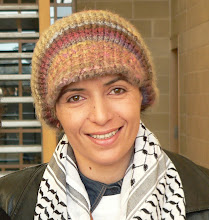
(Panelists of JWS12, Ghada Ageel, Shireen Khamis, and Rela Mazali.)

Part II: Meet Three of your Partners
By Reza Corinne Clifton
PROVIDENCE, RI - I met three incredible women recently: Ghada Ageel, a Muslim Palestinian who was born as a refugee whose current home is in Gaza; Rela Mazali, a Jewish Israeli who was born in 1948, the year the state of Israel was founded; and Shireen Khamis, a Christian Palestinian whose home and family near Bethlehem have been disrupted by a twenty-five foot wall that surrounds her town and segregates it from centuries old neighboring towns.
Ageel, Mazali, and Khamis are the featured speakers of the twelfth “Jerusalem Women Speak: Three Women, Three Faiths, One Shared Vision.” JWS is a national speaking tour organized by Partners for Peace, a Washington D.C.-based, United Nations-registered nongovernmental organization (NGO) with a 501(c)(3) tax status. Partners for Peace was founded in 1998 “to educate the American public about key issues in the effort to secure peace and justice among Palestinians and Israelis.”

A three week-long speaking tour, Partners for Peace Program Coordinator Jacob Pace also arranged a number of media stops along the way, all in the hopes of getting the message out; a message which conveys the difficulty of maintaining hope in a region that has been riddled with military conflict for the past half-century. The stories of Ageel, Mazali, and Khamis are as powerfully stirring as they are shockingly foreign to American ears. Here, in Partnering for Peace in the Middle East, Part II, I have provided a fragment of what each woman had to say, about her home; her everyday life; and her struggle to keep faith that the world will eventually intervene in a just and peace-seeking way.

Ghada Ageel, a Muslim Palestinian, age 35Ghada Ageel’s story “starts in 1948,” she will tell you, when her grandmother’s family was expelled from their home in Beit Daras; it was part of Palestine, but it became part of Israel. Like her parents, Ageel was born in a refugee camp—Khan Younis—in the southern Gaza Strip. Explains Ageel in her own words:
“The refugee-hood was passed through my grandmother, to my father, and my father passed it to me; and now I pass it on to the fourth generation—to my kids.

Usually you get punished because you did something. I was punished before I was born.”
Ageel’s childhood was full of reminders of her status, as a refugee with restrictions placed on her by Israel. “What is refugee camp? It’s a place with misery and poverty and nothing but despair. We’re very close to the beaches and the Mediterranean; it’s very beautiful. I was deprived of enjoying [it] because of these…Israeli illegal settlers who followed us in 1967.”
Ageel and her father shared aspirations of her becoming a doctor, but these were interrupted by the consequences of what is known as the first Intifada or Palestinian uprising. “I’m in high school. I’m waiting for University. Before reaching University…in 1987, 1988, the universities are declared closed by Israel.”

Nevertheless, Ageel was not deterred from individually working for peace. Upon the reopening of universities, she began studying the Hebrew language in Israel, to correspond with the peace process that emerged in the early 1990’s referred to as the Oslo Accords. Ageel explains:
“I go to Israel to study Hebrew language because it’s the peace process—a new era. We have to learn the language of dialogue because [19]48-94,” she approximates, is “around 50 years.”
But the process ultimately fell apart, and contrary to earlier peace accords and United Nations policy, Jewish settlers continued to move into areas denoted as Palestinian territories while the Israeli army continued militarizing Palestinian borders.

As a matter of fact, the borders of Gaza—Ageel’s current home—were so restricted by the Israeli military as of August, that trying to return back home after doing scholarly work in England for her Doctorate in Middle East Politics from the United Kingdom’s University of Exeter, she was denied from entering. “Lucky for Partners for Peace” she says ironically, for with the borders closed, she probably would not have been able to leave for the tour had she been in Gaza instead of England.

Ageel shared other information about how the current infrastructure supports—or really obstructs—the work of peace in Gaza:
“Ten years ago, there [were] demonstrations for peace; activism with Israelis; inviting Israeli delegations; [and] going to Israeli Universities. Now, because politics [have] put [up] these barriers, Rela cannot go to Gaza; I cannot go to Israel…There is no environment even to conduct these kinds of activities—peace activities that could bring people together or make the distance a little bit closer.”

It is information delivered like this, that considers and presents the implications of policy on civilians and families, that makes the Partners for Peace program, and the participation of Ageel and other women so important. “I speak up on behalf of ordinary Palestinians. Usually, the guns are speaking and the media is speaking and a foreigner or correspondent is covering my story or a politician is covering my story. Rarely there is opportunity for ordinary people to talk.”

Ghada makes it clear, though, that like a falling currency, the significance of her here in the US talking to American citizens and to the media may be losing its value with the people there where she lives.
“…for the people in my refugee camp…they view it with hope, though it’s very small hope. Other people and groups…joke about the tour or laugh about it because they’ve lost hope of USAid and their policies and the International Community, United Nations, International Law, Human Rights. “I could face this group if this tour had been before July 2006, but after the [Israel-] Lebanon War…”

Besides a student pursuing her doctorate, Ageel works as an academic counselor for a US Agency for International Development (USAID) organization called The Academy for Educational Development.

Rela Mazali, a Jewish Israeli, age 58Rela Mazali was born in 1948, “into the dream,” she explains, referring to the successful political movement that saw Jews “return” to their historic land. “My mom came from the U.S. She was an activist; was a Zionist-socialist activist, and she chose to leave Kansas City to go to Palestine and do what she thought was establishing a just, egalitarian national homeland.”

All of the women reveal information that is new; they also fearlessly broach topics that might be referred euphemistically as elephants in the room. Early in our conversation, in talking about her mother’s journey, Mazali reveals one:

“Going there, she thought like many of the people who chose to go there from the West, that it was more or less empty; more or less unsettled.” Mazali compares the magnitude of this assumption to the magnitude of assumptions that influenced the American doctrine, Manifest Destiny. She continues with what she calls “another familiar” or similar “narrative” to the American one, saying “And there was also a belief that the Westerners were going there among other things in order to bring process.”

Mazali herself now works with young people in Israel involved in varying degrees of draft resistance, a population Mazali indicates is “really substantial in Jewish-Israeli society.” For her, working with these youth is a great part of why she is still able to maintain “a real sense of energy and hope.” Underexposed, she insists, is “Intentional draft avoidance of the kind that was practiced here on a broader scale in [the war with] Vietnam.”

Her path toward working for anti-militarization and peace was not a direct one. “For many years, I was unable to see what was right before my eyes,” she explains, referring in part to her own military service in a non-combat unit in 1967.

At her post, she was exposed to communications sent from the Israeli military to UN forces that were monitoring the Israeli-Syrian border. “I knew very well that this story [that Israel was reporting] about tractors going out to plow the field and Syrians shelling them just because they were plowing their fields peacefully was not the real story, because the tractors went out to specific parts of what was called ‘No Man’s Land,’ in order to establish presence there—and it was disputed territory.”

Mazali was not yet moved, though. She explains: “So I realized that the narrative we were getting wasn’t what was happening but I still accepted that this was necessary probably; that somebody knew that they were doing.”

Like Ageel—and Khamis—Mazali is now much more critical of and concerned with the broadcasted narratives. She explained one area of her concern at a presentation at RI College, in response to an audience member’s censure of Ageel for using a map that does show changes to the area following the recent departure of Jewish settlers:
“I think that there is a lot of misperception around that, because it’s true that the illegal settlements have been evacuated. There were 7000 settlers in all of Gaza that were evacuated. But Israel controls the whole periphery.”

Mazali is able to cite more information, too. “The military, the Israeli military is all around the Gaza Strip, and pretty often…inside the strip. Incursions into the strip both with helicopters and tanks and foot soldiers and planes happen all the time.”

Referencing the same segregation that Ageel noted, Mazali continues revealing a deeper narrative: “Nobody can get into Gaza or go out of Gaza without Israeli permission. Nobody is registered in the census in Gaza. All of the control of information of who belongs in Gaza and who doesn’t belong in Gaza; who is allowed in and who isn’t is in the hands of the Israelis. It has not been passed to the Palestinians.”

Mazali has noticed a general misperception if not “bias” at how reports are disseminated about Jewish Settlers and Palestinian land. “There has been an enormous amount of building in the settlements in the West Bank. We are talking about the Palestinians living on twenty-percent of the land of historical Palestine, and on that land there is accelerated illegal settlement…and the wall which does not follow the border, but goes inside the West Bank, snaking back and forth in order to protect settlements by and large.”

She is also very preoccupied with the penetration of violence and militarization into every sector of Israeli society. Her organization, New Profile, has documented the use of imagery of young soldiers in conflict for all kinds of marketing—political slogans, beer advertisements, and boxer shorts commercials to name just a few. She also sees the exaltation of the military and war as factors that skew how Israeli society promotes the teaching of the Holocaust. In response to an audience member who criticizes the panelists for not mentioning the Holocaust, this is what Mazali had to say:

“I feel that it is very painful to me to see how in Israel the Holocaust is exploited; literally exploited in order to instill in generation after generation of young people a sense that if we do not use military force, we will be annihilated.

“The children that study the Holocaust in high school are often very directly connected to their very immediate inscription [into the army],” and, she goes on to say, “The Holocaust in many Israeli schools is taught as a national catastrophe, which it is, but not as a universal catastrophe which needs to be averted in any place that it may take place by means which do not include military action.”

Mazali is concerned that “turning the use of the military into the only answer to it”—the Holocaust—cheapens it; moreover, she is afraid that Israeli society and people are suffering by this militaristic sense of priority. She cites twenty-five percent as the number of people in Israel under the poverty line, and one-third as that number of children. She has a firm belief in the connection between the ongoing conflict and Israel’s—and America’s—roles in the aggressions:
“By resisting peace and investing increasing amounts of money—both Israeli and American money—in armament and war and reconstruction after self-destruction, [Israel] is widening the gaps between rich and poor really fast and really dangerously.”

Shireen Khamis (Age 23), a Christian PalestinianLike the other two panelists, Shireen Khamis is very concerned with the question of accuracy and depth in reporting about Israel/Palestine, and how these form the perceptions of the international community. As a matter of fact, one of the first comments she made upon starting her presentation at RIC was “We are the reality and nothing but the reality in Palestine. And if we are not credible enough, go and check the alternative media. Not the American media, but the alternative media…”

For Khamis, reality has been shaped by living in Beit Jala, a town close to one of the holiest areas in the world—“five minutes from Bethlehem,” she describes, and “ten minutes from Jerusalem.” Despite the sanctity of the place, according to Khamis, “This lovely city is nothing but a prison [now] where the population, the citizens, the Palestininian citizens—Christians and Muslims—live on thirteen percent of the original land because eighty-seven percent of the area of Bethlehem was confiscated.”

Despite the frustrations of Khamis and her neighbors and the objections of some members of the International Community, Israel does not seem to be done pursuing land. Khamis explains:
“…[A]lthough 87 percent was confiscated, the Israeli government just wanted more land! It confiscated the Northern part of Bethlehem because…it’s a religious place for Jews. So they made this military zone.” Khamis is very clear about the core of her frustrations as she continues. “No, it’s not important those families that lived there. So they put this great huge wall between the neighbors, between the man and his garden, between the woman and her son.”

Also like Ageel and Mazali, Khamis is hyperaware of and disheartened by the military zone she describes. Taking her role seriously as the youth in the group, she reflects on the effects of these zones and military checkpoints on young Palestinians. She talks about what it is like as a student, describing the journey to school as the first challenge a student faces, and citing statistics to support her claims:
“We have to stop by the checkpoints that the Israeli military created to wait for hours and hours under the heat of the sun, or [in] the rain, so as…to go to our schools [and] universities. More than 225,000 students have to pass through the checkpoints before going to school, and more than 9,300 teachers have to pass through these checkpoints.”

Besides statistics, Khamis relied on photos at her RIC presentation to convey the facts. In the case of the checkpoints, she shows the picture of a group of terrified students and a teacher surrounded by the drawn guns of young, Israeli soldiers. “This is how they are faced,” she recounts, “by the Israeli soldier; how they are humiliated and horrified.” Turning to another photo, she shows how “they couldn’t go to their school, so they had to take the lesson on the ground of the checkpoint.”

Khamis also has photos and stories about women who have given birth at checkpoints, an offense a member of the RIC audience insists, must be a human rights abuse. Pointing to the sheer number of checkpoints in the West Bank alone—500 she cites—Khamis shares that she believes they can be for no other purpose but to “harass and humiliate” Palestinians. She also challenges the Israeli explanation of security, and touches on the disdain for the illegal Jewish settlers mentioned by both Ageel and Mazali:

“But if you want to protect your people, why do you put them inside the Palestinian areas, between me and my neighbor; between me and my school? Why do you put them between us? No, they are just to…make their [Palestinians] days and nights dark, and not only their nights.”
Discussing the Israeli policies of closure and curfews, she continues to spend a majority of the time talking about the numerous effects on youth. “More than two-thirds of Palestinian children are under the poverty line, which is two dollars a day. They are forced to work, to get some money to survive,” she explains, drawing on her work interviewing women and youth for a documentary project with TAM, an organization seeking to empower Palestinian women through media and training.

She has more accounts, related specifically to the implications of the Israeli army’s activities on growing up Palestinian. “They can’t sleep at night,” she shares, and “they can’t study” because of the Israeli airplanes flying and “bombarding” over their school. She also recounts her own, not-too-distant experience as a high school student studying to “the sound of bombarding,” knowing she remembers, “that they are bombarding my grandmother’s house.”

Particularly in her ability to talk about the experiences of youth, Khamis—like Ageel and Mazali—are afraid of the apathy in the U.S. and world community, but secure all the same in the significance of their stories and in their ability to talk to the American citizenry. After numerous accounts dripping with desperation, she looks concertedly at the audience and speaks articulately and faultlessly: “I decided to come to raise my voice and to tell the American people that you are part of this war; you are part of this conflict.”
Persistent about the point, she rephrases it many times, finally capturing it as “When you hear our…presentation, you become responsible because now you know the truth.”
A statement that may just echo in your ears as it has in mine.

On a pamphlet created by Partners for Peace assembled to provide a “Web Resources Guide,” the organizations of Rela Mazali and Ghada Ageel have been listed. Mazali’s New Profile is at www.newprofile.org, and Ageel’s Academy for Educational Development is at www.aed.org.
For more information about Partners for Peace, visit www.partnersforpeace.org, or call 202-863-2951. Or read Partnering for Peace in the Middle East Part I for a list of other organizations or ways to become involved.

Reza Corinne Clifton is a community organizer for high school reform at RI Children’s Crusade for Higher Education. She is also a freelance writer who is regularly published in several RI-area publications. Her articles can be seen at www.RezaRitesRi.com and she can be reached by emailing rezaclif@aol.com.

Thursday, 19 October 2006

'Jerusalem women,' touring as Partners for Peace, fault Israeli policies

HARVARD GAZETTE ARCHIVES

Ghada Ageel, a Palestinian Ph.D. student and Web diarist, listens to a question from the audience. (Staff photos Jon Chase/Harvard News Office)

'Jerusalem women,' touring as Partners for Peace, fault Israeli policies
By Ruth Walker Special to the Harvard News Office

"I am coming here to say, help us. America is involved in this conflict, and is feeding it. Wherever you stand, stand for justice."

That was the contention and the directive of Ghada Ageel, a third-generation Palestinian Muslim refugee, at the Harvard Divinity School Friday (Oct. 13).

She was there as part of "Jerusalem Women Speak," a three-woman panel on a tour of New England sponsored by the organization Partners for Peace, a Washington, D.C.-based nonprofit group. The Pluralism Project sponsored the University event.

Ageel (from left), Shireen Khamis, and Rela Mazali are touring New England together to present their views on the Israeli-Palestinian conflict.

Ageel and her fellow-panelists - Shireen Khamis, a Palestinan Christian from Beit Jala, near Bethlehem, and Rela Mazali, a Jewish Israeli - are touring to speak from their own experience of the Israeli-Palestinian conflict. All three women described themselves at one point or another in the session as relatively "privileged." But they said they saw American news organizations and the U.S. government as biased and unreceptive to reports of Palestinian suffering. This unanimity of views was typical of the session.

Ageel said that her family had been expelled from their homes in 1948 when the state of Israel was established. In May of that year, Israel was recognized as an independent state by the United Nations, an event that precipitated the invasion of the country by its Arab neighbors.
In 1995, during the hopeful moment of the Oslo peace process, Ageel went to Israel to study Hebrew and, for the first time, to meet Israelis and connect with them as human beings. "We could agree on many things," she said. But it was an eye-opener, she said, to see how different the standard of living for Israel was from that of the refugee camp where she had grown up.
Khamis, who said she was part of a Christian community that has been present in Israel since the very beginning of the Christian era, showed pictures of her family's olive trees, marked for destruction by red slashes of paint, and then uprooted by the Israelis, she said, to make way for a new security wall "to protect settlers from all over the world."

Mazali suggested that the stresses of the Palestinian-Israeli conflict were "brutalizing" Israeli society as well as Arabs.

Mazali also shared her experience of trying, and failing, to get into a mainstream Israeli newspaper a report of what she saw as a significant shift in Israeli tactics in what all three panelists called the "occupied territories": Instead of bulldozing the homes of militants - suspected or convicted, she said, the security forces had started destroying them with artillery shells.

She worked her contacts and pulled her strings, but the paper was not interested. It was considered a nonevent, Mazali said. In the paper's view, "It was a piece of reality that's been 'disappeared' from the reality that is passed on to you and to me, too."
Partners for Peace says that it works to bring to American audiences and media "the voices that often go unheard" as part of its advocacy for a "just and lasting settlement of the Israeli-Palestinian conflict." This year's tour, running from Oct. 7 to 24, is the 12th the group has sponsored. The three women hadn't met until they came to the United States and are unlikely to be able to meet again once they return to the Middle East.

It was not exactly a feel-good session.

Mark Braverman, a member of the Partners for Peace board, who introduced the panel, observed, "Confronting this situation creates a crisis of faith. How does one maintain one's faith in the face of evil?"

Mazali thanked her audience simply for being present - "It's not easy to hear what we have to say."

It was also not a session that purported to give both the pros and the cons of the "occupation"; rather, it presented a case against Israeli activities from the perspective of three different communities. Some dissenting voices were raised, however.

An Israeli in the audience, who had spent three years on active duty in the Israeli Defense Forces and another nine years as a reservist, challenged the view of Israeli soldiers at the checkpoints as "inhumane."

Questions from the floor also included one from a Roman Catholic activist who criticized the three for not presenting a fuller picture of Israeli fears and concerns.

Thursday, 1 June 2006

“Prisoners for Freedom”: The Prisoners Issue Before and After Oslo

Abstract
Journal of Palestine Studies
Autumn 2006, Vol. 36, No. 1, Pages 71–80
Posted online on November 20, 2006.
(doi:10.1525/jps.2006.36.1.71)
“Prisoners for Freedom”: The Prisoners Issue Before and After Oslo

Um Jabr Wishah‌

This is the third and final installment of Um Jabr's “life story,” earlier segments of which—on village life in pre-1948 Palestine and on the 1948 war and its aftermath—were published in JPS 138 (winter 2006) and JPS 140 (summer 2006). The current excerpts focus on Um Jabr's intense involvement in the prisoner issue that began when two of her sons were in Israeli jails. In particular, her activism took the form of organizing other women to visit prisoners from Arab countries who had no one to visit them on the twice monthly visits allowed.

Um Jabr's 36,000-word “life story” was one of seven collected as part of an oral history project, as yet unpublished, carried out by Barbara Bill, an Australian who since 1996 has worked with the Women's Empowerment Project of the Gaza Community Mental Health Program, and Ghada Ageel, a refugee from KhanYounis camp now earning her Ph.D. at the University of Exeter in England. The women who participated in the project were interviewed a number of times during the first half of 2001; after the tapes were transcribed, the memories were set down exactly as they were told, the only “editing” being the integration of material from the various interviews into one “life story.” Um Jabr, who was in her early 70s at the time of the interviews, still lives in al-Bureij camp, where she has since 1950.

Wednesday, 8 March 2006

Film Gives Rare Look at Palestinian Women

By KEIJI HIRANO
Kyodo News
In July 1988, Mizue Furui was in the Gaza Strip and West Bank with her camera as a rookie freelance journalist. Mizue Furui Covering the Palestinian condition, she became acquainted with Ghada Ageel, a 23-year-old teacher at an elementary school, in November 1993 and started shooting her life up to when she turned 35.

The 12 years Furui spent shooting still and video images has borne fruit in a documentary titled "Ghada -- Songs of Palestine," which will be released in Uplink Theater in Shibuya Ward, Tokyo, in May as a rare report on women in the traditionally male-oriented Palestinian society.

The film shows Ageel becoming engaged to an engineer, resisting the holding of a traditional wedding party in a bid to break social restrictions on women and giving birth to two children.
It also shows how Palestinian women humor their children or cook even when bullets are flying above their heads.

"I want to tell through my film that ordinary people lead ordinary lives with children, but their hope for peace has not been achieved easily under the occupation," said Furui, 57.
The turning point in Ageel's life came in 2000, when the 13-year-old son of a relative was fatally shot from behind in the intifada, awakening her identity as a Palestinian.

Ageel began collecting and recording narratives and songs performed by elderly Palestinians about their lives and struggles to hand down the stories to later generations.

"Born in a refugee camp, Ghada has led all her life as a refugee, and she has become keen about her own roots since the boy's death and started working on handing down the Palestinians' experiences," Furui said. "I wanted to depict the Palestinians' lives through the eyes of Ghada in this film."

Just as Ageel has tried to overcome conventionalities in her own society, Furui grappled with hardship, in the form of articular rheumatism, when she was still an office worker at age 37.
Ghada Ageel (center) shares stories and songs with some of her Palestinian compatriots.
"I once gave up my life. But after miraculously recovering from the disease, I started taking photographs as I was seeking something to express my feelings," she said.

Her initial subjects were flowers and landscapes, but a photo exhibition in Tokyo showed her Palestinian children leading their lives energetically even under severe conditions.
"I had never turned my lens to a person until then, but the exhibition made me really want to take photos that would sway people's minds and I found myself standing in (Palestinian territory)," she said about her transformation from office worker to journalist.

Even though she was not sure if any news outlets would carry her photos and articles, she visited there frequently "as I was attracted by the Palestinian people and they warmly welcomed me."

"I was also impressed with Palestinian children, who faced fully armed soldiers with stones in the intifada," she added.

Sometimes Furui stayed with Palestinian families for several months to film their lives, particularly those of children and women.

"While I helped in their housework, the women told me their life stories and showed me dancing, making me feel like recording what they do in their own places, such as the kitchen," she said. "At that time, Ghada contributed to my coverage a lot as an interpreter."

Ageel, for her part, said in a video message to a recent Tokyo preview of the film that she has been inspired by Furui as a reporter. She is now working on compiling a book based on the histories told to her by older Palestinians.

Furui's beats now include Afghanistan, Indonesia, Bosnia-Herzegovina and Uganda, and her photos, videos and articles have been carried by major magazines, newspapers and TV news shows.

She has shot more than 500 hours of video in the Palestinian territories. She said she decided to make the film because the time constraints of reports for TV news or documentary programs prevent her from doing the kind of full reporting she would most like to do.
"They (TV news programs) sometimes give me only five minutes even after three months of coverage," she said.

Akihiro Nonaka, who leads Asia Press International, a group of freelance video journalists, said, "So far, people tend to focus mainly on the struggles of Palestinians, but we can see candid pictures of Palestinian women in this film, which have been rarely reported, as a result of Ms. Furui covering them closely."

The film, with English subtitles, was shown in Busan, South Korea, and will be shown in Hong Kong in April, according to Furui, also a member of Asia Press.
"I hope this film will be widely distributed not only domestically but overseas so more and more people will feel close to the Palestinian issue, although they live in a rather (distant) area," Furui said.

Ageel is expected to join Furui in Japan when the film is shown to the general public.
http://search.japantimes.co.jp/cgi-bin/nn20060308f1.html

Thursday, 18 August 2005

Is the world ready to fulfill our dreams?

Ghada Ageel is a Palestinian living in Zahra town, Gaza
Ghada AgeelThursday August 18, 2005
Guardian
There is no doubt that we live through history. For many in the world, the dismantling of Israel's illegal colonies is an implementation of one aspect of international law, that prohibits using occupied land for the use of the occupier. But for Palestinians, this means something bigger and much deeper.
As someone who has lived all my life next to these colonies, and as a mother of two children, this marks the beginning of a new era in my life. During the last five years, I was afraid to look into my children's eyes when we were being subjected to invasions and shelling. There was no guarantee I could provide them with anything beyond my love. Now I hope they will have physical and mental security besides love.
For my family in the Khan Yunis refugee camp, living close to the wire of the Neve Dekalim settlement, this means an end to the fear of being forced to flee in the dead of the night. It means keeping our small home and possessions, and emptying the bag of documents my mother packed in preparation for that moment when our home might be attacked.
For Khalid, aged 10, the withdrawal means he can go to Khan Yunis beach to swim and play, an activity that he, and more than 200,000 Palestinians, have been deprived of because of the Gush Katif settlement block. Khadija Ammar, aged 81, who lives in Khan Yunis, says: "Now I have some hope that my family will be safe ... Before I was terrified to leave this life with only sadness and fear for the destiny of my children and grandchildren."
For ordinary Palestinians, dismantling of the colonies means hope for the better. But this hope will lead us to many questions: Is the world ready to fulfill these Palestinian hopes and dreams? Will Gaza be the first step, and the West Bank and Jerusalem the next, towards a Palestinian state? Will they use this opportunity to move peace forward, or leave us to the cycle of despair and violence again?

Thursday, 12 August 2004

The Home of My Closest Friend Has Been Demolished


Earlier this week the Israeli military demolished the home of my closest friend. To stand in the rubble of the home that witnessed the best days of my childhood is devastating. In her home I learned the meaning of love, care, and true friendship. It is all gone now.

As with my parents and grandparents homes in Israel, we are left now with only the memories. A decade ago when I went to Hebrew classes in Israel to build a better future I would not have believed that Israel would still be occupying Gaza in 2004. I do not understand how Israel thinks it will strengthen voices for peace like mine when it demolishes Innocent people homes at the very moment it is telling the world it plans to exit Gaza. My stomach turns at the thought that Sharon needs to demolish my friend’s home in order to look sufficiently tough to "sell" this plan to the Israeli public.

The Israeli army is advancing fast and our turn is coming. I visited this area a week ago and my friend's home was still standing. My own family home is five rows far from her home. We moved to Gaza over half a century ago after being forced out of Israel.Now, we may be forced to flee in the dead of night once again.

By the meager means available to me, I have reported to the world this tragedy of home demolitions many times before. But it is substantially different when you report about the home demolition of someone you don't know and then report about homes you know very well.

I now better understand the magic connection and the flash of my grandmother's eyes when she speaks about her demolished home and village in Bait Daras from which she was spit out 56 years ago.

Do Democrats and Republicans not understand that when they speak of the "Jewish state of Israel" they are talking about the ethnic cleansing of my grandmother? What has become of the "fair play" of the American people that they now justify such state terror? Are justice and compassion no longer of concern to the American people and their leaders?

My grandmother did not forget. I asked her once to forgive so that my daughter Ghaida and I could live happily. Now Ghaida and I will be unable to forget or forgive these daily atrocities. What is transpiring in Beit Hanoun, Rafah, and Khan Younis is more savage than an eye for an eye.

Every time the Israeli occupation forces demolish homes they expand the wire further, swallowing more and more of what little land remains to us. It's as if they are determined to strip us of the final dreams and possessions that we hold. Psychologically they appear intent on depriving us even of the hope that next year they will have left all of Gaza, albeit leaving us confined within an enormous open-air prison, Â newly dubbed by Amir Oren as an occupation by remote control.

The same razing of homes taking place in Khan Yunis is going on in Rafah and Beit Hanoun. The policy is the equivalent of Guatemala's scorched earth policy against the indigenous people there. At this rate, we will have no infrastructure, no land or space, notrees or agriculture. Already Israelis are consuming a disproportionate amount of our water resources.

To leave your neighbor with nothing but despair, bitterness, and anger does not bode well for the future of either Palestinians or Israelis. Our situation will be extraordinarily difficult if we are left with nothing more than a pulverized desert strip of land.

Sharon himself seems to be acting more out of anger and revenge than from a considered and rational policy. His approach to getting out of Gaza is extremely unsettling. He seems hell-bent on making this place either ungovernable or a fiery place of unquenchable rage that is controlled by isolated pockets of armed young men running for their lives but unable to think the coherent thoughts necessary to build our future.

These young men are determined to protect us and some of them will make fine leaders in years to come, but they are ill-equipped to govern today. Sharon knows this. And he knows that chaos in Gaza strengthens his grip on the West Bank and East Jerusalem which are his true goals.

As a girl and young woman I used to find my own strength in my grandmother's eyes. Now, this woman who has seen so much has only sadness and a dead, haunted look. I, myself, am afraid to look to my daughter's eyes. There is no guarantee I can provideher beyond my own love. I certainly cannot guarantee her physical and mental security.

Last week I left Ghaida with my extended family in Khan Yunis when I had to be in Gaza City. I was shocked to learn that my precious child was upstairs sweeping the floor while gunfire raged nearby. When I talked to her about this and how dangerous it is she told me that she misses her relatives who have been killed. She said that if she got shot andKilled she would go to see them. She spoke of her love for them. The open discussion of the possibility of being killed, from a child so young, is terrifying. How will she turn out, living amidst such uncertainty and trauma?

Haters of Palestinians say that we saturate our children in a culture of death. But how do we insulate them from the gunfire of an ostensibly withdrawing army that is laying waste to our refugee camp?

The world has gone deaf and blind to our struggle. Fifty-six years after our national catastrophe at the hands of the United Nations, where is Kofi Anan? Why does he not speak out for us more vigorously? The nations of the world should remember well that there once were Palestinians willing to reconcile. But when Israel's parting gift is to threaten the home of my memories this becomes well-nigh impossible.

To the people of Israel: You claim to be leaving Gaza next year. Why then demolish my neighbor's home, and perhaps my own, on the way out? You leave us no choice but to remember our old dreams -- not to return to our homes in Khan Younis refugee camp but to the homes and land you stole from us 56 years ago. Ironically, you have returned to me my memory and my grandmother’s memory of the future. There is madness to the policy you pursue today. And if you are wise, it will end without delay.

Finally, Mr. Bush: Whatever happened to "riding herd" on the both of us? Instead, you have abandoned us to the gentle mercies of Ariel Sharon who says one thing to the world about disengagement while at the same time marauding through the neighborhoods of my youth, devastating lives and landscape alike, with not a thought to the reality that we are destined to live as neighbors.

Sunday, 16 May 2004

Gaza: horror beyond belief

Ghada Ageel writing from ZAHRA, occupied Palestine, Live from Palestine, 16 May 2004
Mohammed, 3, son of Ibrahim Abu Auda, during Israeli shooting in Rafah at 3:30AM, July 2002. Their house is 40 meters from the Gaza-Egyptian border. (Johannes Abeling)
The situation in Gaza is horrific beyond belief.
Since Tuesday, May 11, thousands of people have been denied the simple right to return to their homes; this includes infants, children, students, employees, women, and men of all ages. There is no law in this life or world that should prevent someone from returning to his or her home.
Yet in Palestine this is happening. And it is Israel, the storied democratic state, that is practicing this grave violation of very basic human rights.
Tens of thousands of students and employees came from the south of the strip (Khan Younis and Rafah) to Gaza City for university studies, work, and for other various needs. They got stuck in Gaza after Israel closed all the internal checkpoints in the strip -- dividing it into three separate parts.
My mother was one of those people. She came to visit my sister in Gaza City on Monday afternoon. She was planning to stay overnight and go back home on Tuesday morning. But on Tuesday morning she was jolted by the news of the closure and by what was going on in the Zeitoun neighborhood of Gaza City, which is very close to the Sabra neighborhood where my sister lives.
Like everyone else in the Strip she has followed the news not only via television and radio, but by watching and hearing the rockets launched by the Israeli combat helicopters which hovered over the buildings of Sabra and rocketed Zeitoun with air-to-ground missiles and shelled the neighborhood with high-explosive ammunition.
To reach Khan Younis refugee camp, she has to cross two checkpoints. The first is beside the illegal Israeli settlement of Netzarim where the tanks stand by two huge hills of sands. These tanks close off access to the coastal road and block anyone intending to cross. The second checkpoint is the one between Khan Younis and Deir Al-Baleh. This is Abu Holi checkpoint (so designated on account of the family name of the owner of the land and to call to memory that it was this family's land that Israel confiscated and uprooted for the checkpoint).
On Tuesday, my mother decided that the next day she would cross the first checkpoint.This is easy compared to Abu Holi. She was dying from worry for my two brothers and my sister whom she left alone at Khan Younis camp as it was subjected to several largely unreported incursions in the last few days. She was terrified that the army might invade Khan Younis while she was in Gaza. The fear is always there that something more might happen to our family. She wants to be with them at such times no matter the cost. But it is especially important to her now with my father in Egypt and there being no older family members with them. My sister and I failed to convince her to give up her idea.
We agreed that she get a taxi from Sabra to the northern part of Netzarim where I would meet her. And because we cannot use the main road where the tanks stand, we have to circumnavigate this via a one kilometer trek on the beach before we can use the main road again to get another taxi. I walked half an hour on foot to meet her. Many children and students also made the trek. The army shot above our heads many times. At such moments we ran -- myself every bit as much as the children and students around me.
I was notorious in my family for liking to run as a child. Now I run because my life may depend on it. But running on the sandy Gaza beach was extremely difficult. Some people, in their haste and fear, lost their shoes while running, but continued barefooted. Others were holding their shoes in their hands and running.
Many old women were crying after they fell to the ground and the sea water made their clothes wet. It was humiliating and yet I continued running. When I met my mom on the other side I started to worry about how I could get her safely to the other side. She cannot run. She cannot walk for even three minutes without sitting for a break. Then we saw the donkeys with carts coming to carry people. We paid four shekels and got on the cart. The donkey owner asked us to hold carefully to the edges of the cart and lie flat on it if there was any shooting. If so, we would then have to pick up the pace.
It is crazy. But in our situation today, nothing is normal. We sat. The driver ran alongside us. I closed my eyes and cried in silence. For a minute I wished that my mother had not brought me into this life. The 14-year-old driver saw my tears and told me to cheer up. At least, he said, you are not in Zeitoun where people are getting slaughtered. You have a chance to survive.
It was, he claimed, only another two minutes before we would arrive. And, after all, if anything happened there was a cameraman to take our picture. Apparently not all the journalists were blocked at Erez checkpoint on their way into Gaza. Some had obviously arrived earlier or were with the Palestinian press.
Despite all the hazards we succeeded in crossing. My mother was so happy and for a minute I was happy for her happiness.
We arrived at my apartment. The first leg of the trip was done. We decided to take a short break before continuing to Abu Holi checkpoint.
While listening to the radio we heard that the IDF opened Abu Holi. Quickly, my husband Nasser got our two kids and we raced to our car. More slowly, I helped my mother. We drove as fast as the engine could bear. My mother was so happy that she would go home. But her happiness did not endure. We arrived two minutes after the checkpoint was closed. The IDF had opened it for a scant 20 minutes. We waited for four hours before we returned home. My mother was so disappointed.
She could not sleep that night so on Thursday morning at 8:00 am I again took her to the checkpoint. It was so hot and thousands of people were there waiting. They all were praying that the army would let them cross. People were following the news and they learned more about the destruction at Zeitoun after the pervasiveness of the damage became clear following the IDF withdrawal. They also heard about the Apache helicopter strike in Rafah which left 13 people dead. Two girls, who were relatives of one of those killed, were seized by hysteria and tears. People at the checkpoint tried to calm them.
There was a woman who had left her 5-week-old infant and come to see the doctor in Gaza City. She could not return home. There was a young man who came to get his certificate stamped in search of a job, but got stuck.
The faces of the people were pelted by the relentless force of the sun. Many of them spent the night under the trees or sleeping in their taxis. Some returned to the middle camps or Gaza City to sleep with friends. Students who spent all their money on transportation going to and out of the checkpoint were sitting in great despair with nothing to do.
People were calling the Red Cross, UNRWA, the Egyptian Representative's office, and the Red Crescent asking them to try to contact or pressure the Israelis to open the checkpoint. Then, in the middle of the day, two mature men went to the Israeli soldiers and pulled off their shirts and put their hands above their heads in an attempt to speak to them.
After they explained the situation from a great distance -- a scenario that of course did not need any explanation beyond a simple glance the faces of the waiting people -- the soldier promised to open if we remained quiet. We remained quiet for six hours in the hope that they would open. It was not until 4:30 pm that people started to approach the checkpoint again in another attempt to speak to the soldiers or even to walk through.
Suddenly, the soldiers started to shoot using live bullets and tear gas grenades. The tanks and the jeeps started to drive towards us. I took my mum from the taxi where she had been sitting for eight hours and we started to run. Every single one of us tried to escape. I was holding my young son Tarek with one hand and helping my mother with the other while Ghaida, my young daughter, was screaming somewhere close by.
My mother -- my mother! -- fell to the ground and people carried her. I carried Tarek and ran far from the gas. I shouted and called to Ghaida. She was shouting for me somewhere nearby, but out of sight. As a mother, these moments were the worst.
Five people got injured and approximately 10 were rendered unconscious by the gas. Ambulance sirens started to be heard and I still could not locate Ghaida. The shooting was still going on and the wheat field beside the checkpoint had caught on fire.
No words can adequately express the fear and humiliation of those minutes. And you wonder for a moment what life is this? Do we, too, not deserve to live as human beings?
Even after what happened, people still maintained hope that the IDF would open the checkpoint. And again we sat quiet in lines; hundreds of grim faces waiting. I tried to convince my mum to return to my apartment, but she had hope that they would open. She said the soldier promised the two men to open and they might honor their commitment. By now I had found Ghaida. She, at age eight, and Tarek, who is nearly four, were so tired and their faces were yellow.
We sat for another two hours for my mother. Again the bulldozers accompanied by the tanks started to move. They brought sand and began to close the road. We were thinking that they were cleaning or leveling the area but they were closing the road.
People started to scream in one voice: No, please, do not close, let us go. There was no act violent act from those waiting, either by way of action or words, but they started to shoot again.
By now, it was around 7:00 pm. The same scene as before was repeated. But this time we escaped with no hope -- just with great despair -- after more than 10 hours of waiting.
Almost every woman and child was crying or screaming. Men were helping and I could not look at my mum's face. I had no words to say. I again noticed how tired my children looked. On our way back there was complete silence. Even our tears were spent. I wished that my mother could speak or cry to relieve her stress and heartache, but she did not.
The same exhausting wait happened on Friday, but this time we were not there. We decided not to go, but to call people we knew at the checkpoint to get the news.
There is no conclusion to this story. Tomorrow, we will wait again. Will we walk forward to our destination or will my heartsick mother fall unceremoniously to the ground and be borne away in retreat from gas, bullets, and hate?
Ghada Ageel lives in Zahra, Gaza Strip. Her story was delivered in three parts on account of the inconsistent electricity in Gaza. This time, her mother was able to make it home to Khan Younis on Saturday. Mike F. Brown assisted with editing the text.

Palestinian refugees sit at Khan Younis refugee camp

Palestinian refugees sit at Khan Younis refugee camp